

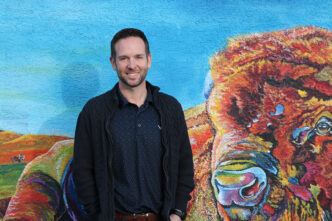

After nearly two years as executive director of the Lloydminster Men’s Shelter, Kagan Kneen reflected on his tenure during an interview with the Meridian Source.
Read more: Kagan Kneen steps into CEO role with LRHF
He’s officially hanging up his hat at the shelter on Dec. 5 before settling into his new role as the CEO of the Lloydminster Region Health Foundation on Dec. 8.
Kneen, who worked corporate jobs prior to joining the non-profit, says he was looking for something more fulfilling.
“I’d done corporate for most of my career. Sure, the money was good, but at the end of the day, it wasn’t fulfilling,” he said. “I really wanted to give back to community; I wanted to help out the clients we served.”
He said he had the opportunity to work with non-profits while working in Calgary.
“When I owned my own company in Calgary, I worked with another non-profit. It was a women’s that were expecting shelter,” said Kneen, noting he built great relationships with the CEO and executive director.
“I did a lot of fundraising with them and just always felt like something was missing.”
When the job at the Lloydminster Men’s Shelter came up, Keen jumped at the opportunity.
“When I saw the opportunity for this posting, for the men’s shelter, I called right away,” said Kneen.
Almost two years later, he says the role has been challenging but rewarding.
“As challenging as the role has been, it has probably been the most rewarding position I’ve ever had,” he said. “I’m very proud of the work we’ve done.”
Since taking on the role, Kneen put one foot in front of the other as he ran from the B.C. border to the Saskatchewan border in an effort to raise money for a new shelter.
The inaugural Running for Shelter was a chance for Kneen to get eyes on the men’s shelter and talk about the efforts they were making to better the organization. He says the run gave him a chance to visit different shelters and learn from what he was seeing.
“Seeing how different shelters operated, policies they’ve rolled out, being able to connect with a lot of different decision makers and figure out what we could do differently,” he explained. “Not just to better serve the clientele, but also the community as a whole.”
When the campaign finished, they unfortunately weren’t able to get a new facility, something he says was a blessing in disguise.
“It didn’t go through, which in hindsight was a blessing. We learned a lot from that,” said Kneen. “We took feedback from the public, we talked to different community members, talked to different organizations who serve the unhoused.”
He says they were able to join a pilot project and are now one of five housing-focused certified shelters in all of Alberta.
“It’s changed completely how we operate as an organization,” he said. “Anybody that comes through the doors, they’re working with our caseworkers on housing solutions, employment, addictions and recovery. Each person is constantly working on a case-management perspective.”
Kneen says his initial Running for Shelter campaign also helped him gain perspective.
“I think that was the turning page to immerse myself into being unhoused,” he said. “Sleeping in a tent for 26 days, running across the two provinces and realizing, I’m exhausted today. That’s why lots of unhoused people sleep during the day. If there was a storm the night before, they didn’t get any sleep.”
He turned the Running for Shelter into a capital campaign that would exist even after he left.
“I really wanted it to be a community thing and I didn’t want it to revolve around myself,” he explained. “I wanted it to be something that was sustainable long-term.”
Kneen turned his run into a 5K walk and run the whole community could participate in.
He says a challenge he faced in his time with the men’s shelter was navigating the bi-provincial nature of Lloydminster.
“Lloydminster being a Border City, from a funding perspective for grants, that’s the big challenge; it’s tough,” he said.
Kneen says the organization is heading towards having transitional housing to get people from the shelter into something more sustainable.
“We need to move into more transitional housing units; that’s where we’re going as an organization,” he said.
He said working at the shelter put into perspective how crucial having support is, recalling a time in his own life when he wasn’t sure where he’d be without it.
“If I didn’t have the support in my family, I don’t think I would have ended up where I’m at today,” said Kneen. “I have phenomenal support. But there’s a lot of individuals here that don’t have family support or don’t have that friend connection.”
He says his position at the shelter has helped him understand what the unhoused go through.
“Getting to know the clients, hearing their stories, dealing with others who struggle, financially, mentally. It’s really put everything into perspective,” he said.
When looking back at the last year, Kneen says there’s one accomplishment that outshines the rest.
“I think the fact that we’re moving towards being housing focussed. The goal should be, this is not permanency, a shelter is not permanency,” he said. “It is emergency to provide additional supports, connections, ID recovery, recovery solutions.
“To be able to actually be a housing-focused shelter, knowing everybody in the shelter has a goal to find their own place.”
He says he’s happy to have had the opportunity to lead the shelter.
“I’m just so grateful to have had the opportunity,” said Kneen. “I know the community doesn’t see all of the faces working every single day with our clients. Our caseworker, operations manager, our direct care workers; we are so blessed as an organization we have had very minimal turnover.
“There’s a lot of heart behind these four little walls that serve 28 individuals.”
In his time at the shelter, plenty has changed. He’s spearheaded major fundraising and cleanup efforts and under his leadership, the model of feeding everyone changed to only those staying at the shelter. He also brought on a caseworker to help get people out of the system.
Read more: Lloydminster Recovery week finishes with Running for Shelter