


Rotarians rang in the new year by learning about a successful local pilot program aimed at supporting people experiencing mental health distress or crisis.
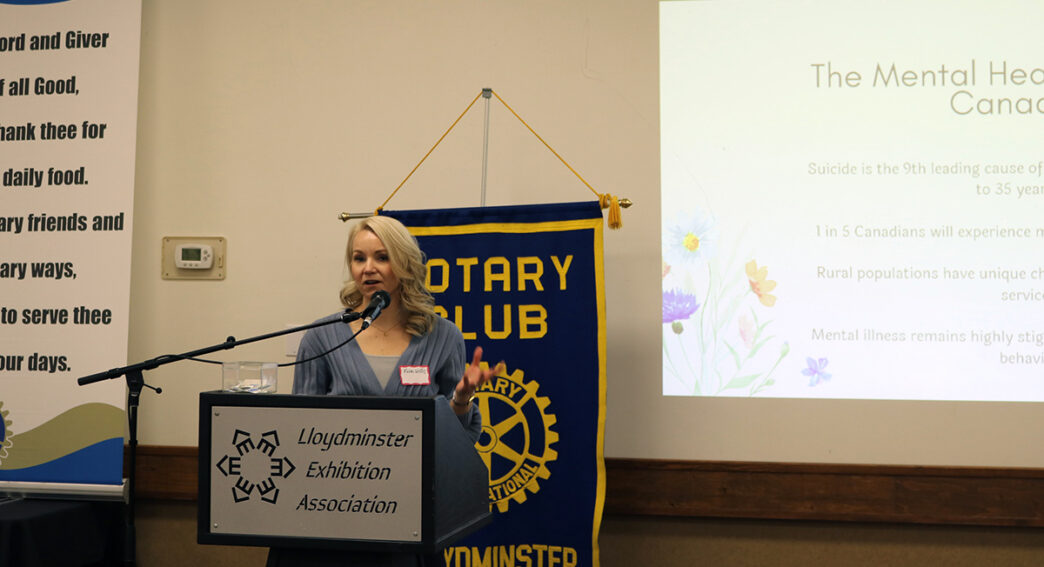
At the Jan. 5 Rotary Club of Lloydminster lunch meeting, Falon Willis, clinical counsellor with Integrated Therapies & Performance and Integrated Therapies owner Christy Hunt, talked about the pilot project, Pathway to Wellness.
Read more: Sports year in review: Bisons outlast Bandits for crown
The project, which was developed for Willis to finish her masters’ program, addresses a gap in health care.
“Where we live in rural communities, a big concern is access to those specialized treatments and services,” said Willis. “We have a lack of rapid mental health crisis response services.”
Willis said people are often uncomfortable talking about their mental health. She noted many are accustomed to going to the emergency room during a crisis, but in some cases, people leave without receiving treatment.
“We have a lot of people that often leave the emergency room without being treated,” she said. “So, their conditions worsen because they’re not getting the support they need.
“This increases (the) feeling of helplessness or hopelessness.”
Willis explains it’s important for people to get treated as early as possible.
“In any type of health situation, the earlier you can intervene, the better the outcome’s going to be,” she said.
She says they’ve done a lot of research, diving into a variety of articles and studies, which note a quiet place helps people experiencing a mental health crisis.
“What has been found, what really helps people when they’re experiencing a mental health crisis, is to be in a place that is quiet, where they feel like their concerns are being understood, where they feel validated, where they feel like people are actually caring about them and what’s happening to them,” said Willis.
The pilot project, Pathway to Wellness, a walk-in crisis clinic, started in late May and concluded at the end of November.
“What we did with Pathway to Wellness is we started a walk-in crisis clinic for mental health concerns,” she said. “They were able to come to our clinic, Monday to Friday from 1 p.m. to 5 p.m. and see a counsellor who was trained in crisis response.”
She says though things started out slow, as awareness built and school resumed, they had pretty consistent responses from people.
“One of the key takeaways people who accessed the service shared with us was how significant it was to have someone acknowledge them when they said they were experiencing a mental health crisis,” said Willis.
There was no cost or fee for the service, and within 48 to 72 hours, they’d get a follow-up call checking on them and to see if they’d connected with other services.
“When you call people, they’re just so surprised you remember them,” she said.
A variety of data were collected from the pilot program. Notably, crisis support was provided to patients ranging in age from 8 to 63.
“We’ve had children as young as eight years old, all the way to people that are in their 60s access the service,” said Willis.
The program was accessed 143 times with more than 100 different people accessing the distress centre services. Of those who accessed services, 27 per cent were Saskatchewan residents and 73 per cent were Alberta residents.
Trauma was also a significant and consistent factor with 92 per cent of clients reported experiencing trauma.
Session times varied from 30 to 120 minutes with an average of just over an hour.
Safety was a key consideration for the team before sessions began. Clients were informed that if the facilitator felt they wouldn’t be safe leaving, further plans would be made.
“Most people, when they leave, we’re feeling they are safe. We make sure they have a safety plan in place,” said Willis.
The program was made possible through a partnership with the Lloydminster Region Health Foundation, Project Sunrise and Integrated Therapies and Performance.
“Because of that, we were able to operate through a partnership with the health foundation and Christy Hunt’s generosity,” said Willis. “No one was charged for the hours I and other people worked.”
She says when it comes to the program continuing, the numbers speak for themselves.
“I think the statistics show, and the stories show, that this is something our community really needs,” she said.
While the program previously operated Monday to Friday, 1 to 5 p.m., they’ve modified the hours to ensure they can keep it going for a little longer.
“Right now, because we want to keep it going but we don’t have funding, we’ve kind of pivoted to a bit of an alternative format,” said Willis, noting the program can continue with the current model for a few months.
“So, Monday, Wednesdays and Fridays there’s in-person. There’s somebody there. Then Tuesdays and Thursdays, we have call-in service.”
Integrated Therapies is looking to make this program sustainable.
“We definitely are trying to figure out a way to make this sustainable,” said owner Christy Hunt. “It has cost probably close to $100,000 we think, to be able to run this.”
Willis explains being a Border City has caused some complications.
“Because we’re Alberta and Saskatchewan, right now, the way we have it set up is, we really tried to reduce any type of barriers so people can access it regardless of where they live,” she said.
If residents are looking to access Pathway to Wellness, they can do so by calling 780-205-9593 or through email at pa******@***********************es.com.
Read more: Sports year in review: Lloyd throws support behind ailing QB