

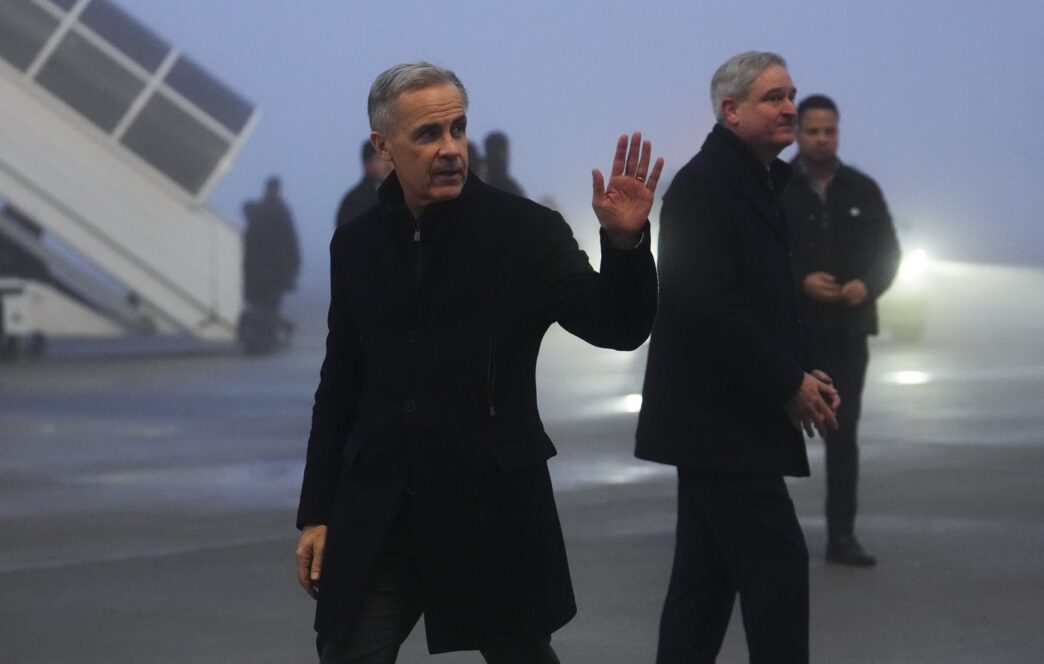
OTTAWA — Prime Minister Mark Carney headed home Wednesday after a trip that saw him circle the globe trying to drum up non-U.S. trade while setting a new tone in diplomacy.
Here are five key takeaways from the trip:
The speech heard around the world
Carney’s address Tuesday to the World Economic Forum in Davos, Switzerland, won praise around the world and from corners of the conservative movement in Canada.
The prime minister called on middle powers to band together against economic coercion by “great powers” and painted a grim picture of a world where those powers use economic dominance for political coercion.
Carney said countries like Canada can’t continue to pretend the world hasn’t changed and called out double standards in how countries talk about a rules-based global order that is increasingly falling apart.
“In a world of great power rivalry, the countries in between have a choice: compete with each other for favour, or to combine to create a third path with impact,” he said in a speech that drew a standing ovation.
The speech sketched out a vision of diplomacy Carney has talked about in recent months — where countries agree to collaborate on specific aims instead of in permanent, broad alliances.
Resolving some canola and EV tariffs
The headline result from Carney’s visit to China was a sharp reduction in China’s duties on Canadian agricultural products in exchange for Canada allowing some Chinese electric vehicles into the country.
Ottawa expects Beijing to drop canola seed duties to 15 per cent from 84 per cent by March 1.
Canadian canola meal, lobsters, crabs and peas will no longer be subject to Chinese “anti-discrimination” tariffs from March to at least the end of the year. There was no mention of canola oil, which is subject to a 100 per cent tariff.
In return, up to 49,000 Chinese electric vehicles will be allowed into the Canadian market each year at a 6.1 per cent tariff rate instead of the current 100 per cent tariff.
Carney said he expects this move will drive future Chinese investments into Canada’s auto sector within three years, while Ontario Premier Doug Ford has framed it as a threat to his province’s auto industry.
Greenland position
While Carney was in the Middle East, U.S. President Donald Trump called for new tariffs on eight European nations which have refused to support his goal of taking over Greenland.
Trump’s threat came as European troops joined Danish sovereignty military exercises in Greenland. The nations sending troops said they were in Greenland to assess the state of Arctic security.
Trump and some of his advisers suggested this was meant to be a show of force to thwart a U.S. invasion, even though European sent a very small complement of personnel. Finland reportedly sent just two liaison officers.
Throughout the week, Ottawa would not confirm media reports citing unnamed sources saying Canada was sending troops to Greenland. Ottawa said only that Canada takes part in NATO exercises regularly.
Carney took a strong position on Greenland’s territorial integrity, saying the future of Greenland rests solely with the territory and Denmark and Canada “stands firmly” with the region.
Gulf investments
During a stop in Qatar, Carney said the country will make “significant” investments in major projects in Canada which will “supercharge” the energy sector and create jobs for Canadians.
Carney said that after years of stalled negotiations, Canada is looking to finalize the Investment Promotion and Protection Agreement with Qatar by this summer. Canada is also expected to install a defence attaché in Doha to deepen those partnerships.
The partnership comes as Qatar faces scrutiny over its alleged exploitation of migrant workers, restrictions on free expression and increasing surveillance.
University of Ottawa professor Thomas Juneau, an expert on the Persian Gulf, said Canada is unlikely to have a material influence over the internal politics of Qatar, though Carney may still choose to raise human rights issues behind closed doors.
He said it’s up to Canadians and their governments to decide if building relations with Qatar is worthwhile in the face of economic threats from the U.S. — or if those human rights concerns amount to a red line.
A recalibration with China
Canada and China also signed a series of agreements to restart various working groups and institutional mechanisms to boost interpersonal and economic activity between both countries.
Through the Canada-China Joint Committee on Culture, both countries will look to attract more tourists by, for example, having Chinese state media film content in Canada about tourism sites.
In August 2023, China lifted a pandemic ban on group tours to numerous countries but kept its tourists effectively barred from group visits to Canada. It lifted those restrictions last November.
The Chinese embassy in Ottawa said at the time this measure was in response to the Trudeau government having “hyped up” the issue of foreign interference and an increase in anti-Asian discrimination.
Carney said Canada welcomes Chinese plans to “significantly scale up their investment” in the country in major clean energy, agriculture and consumer projects.
Meanwhile, Carney said that President Xi Jinping “has committed to ensuring visa-free access for Canadians travelling to China.” Beijing has yet to confirm that this is going ahead, or when.
Foreign Affairs Minister Anita Anand also announced her Chinese counterpart, Wang Yi, will come to Canada this year. When Wang visited Ottawa in 2016, he berated a press gallery journalist who asked about human rights and the jailing of Canadian citizens.
This report by The Canadian Press was first published Jan. 21, 2026.
— With files from Kyle Duggan and Craig Lord
Dylan Robertson and Alessia Passafiume, The Canadian Press