


OTTAWA — China’s ambassador to Canada is urging the government to move fast and make progress on areas of collaboration both countries agreed to during Prime Minister Mark Carney’s visit to Beijing last week.
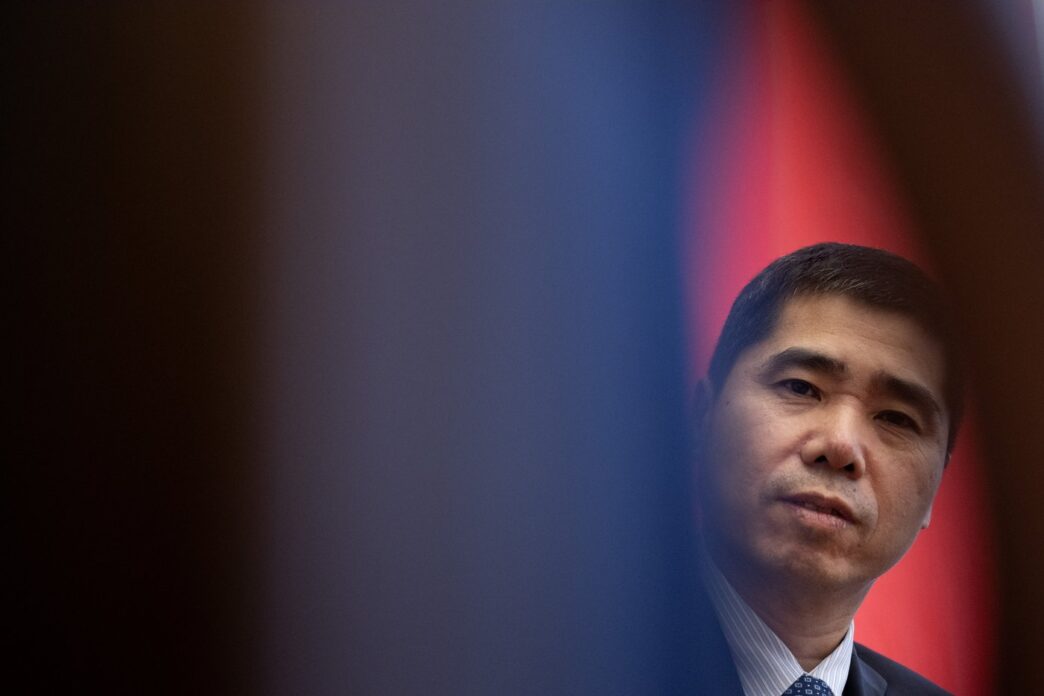
“As long as both China and Canada have adequate sincerity, both sides will be able to translate the important outcomes into reality,” Chinese Ambassador to Canada Wang Di told The Canadian Press, in his first interview since Carney’s Beijing visit.
“The most important task for both sides is to respond as soon as possible to the expectation of the two peoples and to move along the direction that has been pointed out by the leaders of our two countries.”
During that visit, President Xi Jinping and Carney agreed to resolve a tariff dispute that had Beijing put levies on agricultural goods from Canada in retaliation for Ottawa’s tariffs on electrical vehicles from China.
The two sides also signed memorandums to reboot working groups and institutional mechanisms that touched on fields such as finance, lumber, oil, green technology and tourism. Wang said these agreements mean that government departments in China and Canada will be in touch more, and move faster on priority areas.
Carney has said he’ll return to China in November for the APEC summit in the city of Shenzhen, and Wang said that gives 10 months for both sides to make progress on deepening their collaboration.
“That requires us to lose no time and work faster to achieve more outcomes,” Wang said through his interpreter.
That way, both leaders “will be able to discuss the future development of China-Canada relations at a higher level.”
The areas of collaboration between both countries did not include those Carney has deemed sensitive to Canada’s national security, such as artificial intelligence, critical minerals and defence. Analysts have also flagged these sectors as important to Americans, raising the risk of upending continental trade talks with Washington if Canada opens too much to China.
Wang said Beijing is aware of these concerns, and is trying to pursue deeper collaboration in fields that are on the table.
He noted Beijing’s call for “seeking common ground while reserving the differences,” a motto China has said for years in statements regarding Canada.
“The character of China-Canada relationship is win-win and mutual benefit. China and Canada are also highly complementary with each other,” Wang said.
“There is great potential and promising prospects for China and Canada to leverage our complementary advantages and realize mutual benefits. But of course, at the same time, we do not deny that there are differences between China and Canada.”
Carney has sought to frame his approach as a “recalibration” of Canada’s relationship with China, instead of a full reset.
That means Ottawa still has concerns on matters of foreign interference, human rights and the South China Sea — but is putting the emphasis of public remarks on potential for co-operation with China instead of matters where the two deeply disagree.
It’s unclear what that means for Ottawa’s Indo-Pacific strategy, which was released in late 2022 and called Beijing a “disruptive global power” whose values increasingly differ from those of Canada. The strategy called for more collaboration with various Asian nations to limit Canada’s exposure to Beijing.
In October, Foreign Affairs Minister Anita Anand said she told her department to update the strategy, saying it no longer reflects evolving relations with both China and India.
Wang said it’s up to Canada to decide what a new regional strategy looks like, but he admits the Indo-Pacific strategy caused “serious concern” to China since it was released. He said its framing doesn’t fit with both leaders talking of a new “strategic partnership” with Canadian government that brands itself as new.
“The Indo-Pacific strategy is inconsistent with this new strategic partnership, with the new era that we are in, and with the policy that the Canadian government is having,” he said.
Analysts have urged caution in how Canada engages with China, with some suggesting Canada should pragmatically raise concerns on issues like human rights, and escalate those concerns publicly through joint statements with like-minded countries.
Others have accused Beijing of trying to buy silence by using economic sway to incentivize countries to look past points of disagreement.
Wang said people in both countries are facing a turbulent world where they expect leaders to provide opportunities and stability. Industry leaders on both sides have “very high expectations” from the visit, he said, and so it’s now on officials to “translate the important outcomes of this visit into reality as soon as possible.”
Wang also said he hopes ties get deeper when Anand welcomes her Chinese counterpart, Wang Yi, to Canada at some point this year.
“History has proven it very well that whenever China and Canada pull in the same direction toward the same goal, we have been able to achieve a lot,” the ambassador said.
This report by The Canadian Press was first published Jan. 22, 2026.
Dylan Robertson, The Canadian Press