

February 2026 marks the 30th anniversary of Black History Month in Canada.
The month celebrates the legacy and contributions of Black Canadians and their communities. Plenty of stories will be shared this year and I was moved by the words of Coun. Michele Charles Gustafson as she kicked off Black History Month with her comments around the council table.
At the end of her comments, she invited people to hear from author Leander Lane. He will be speaking at the Lloydminster Museum and Archives on Feb. 28 at 2 p.m., sharing his experiences reconnecting with his roots in the Shiloh community.
Read more: Column: The first mayor of Lloydminster
It’s this community that has piqued my interest this week. I’d like to preface this by saying, I’ve read a lot of interviews and stories on this subject and I encourage you to do the same. You will almost certainly learn more and garner a better appreciation for topics like this if you read more about it.
The story of the Shiloh community starts south of the border in the United States. Following the American Civil War, tens of thousands of former slaves began migrating to Oklahoma Territory where they could vote, study and live in relative freedom. It was in 1907 when there was a big change. Oklahoma had achieved statehood and elected a segregationist state government.
A Black Baptist congregation from Oklahoma was drawn to Saskatchewan in search of a life free from segregation and racism. With the promise of free land, about 12 Black families, many of whom were former slaves or descendants of former slaves, arrived in Saskatchewan in 1910 and settled in the Eldon district.
The community would grow to more than 50 families.
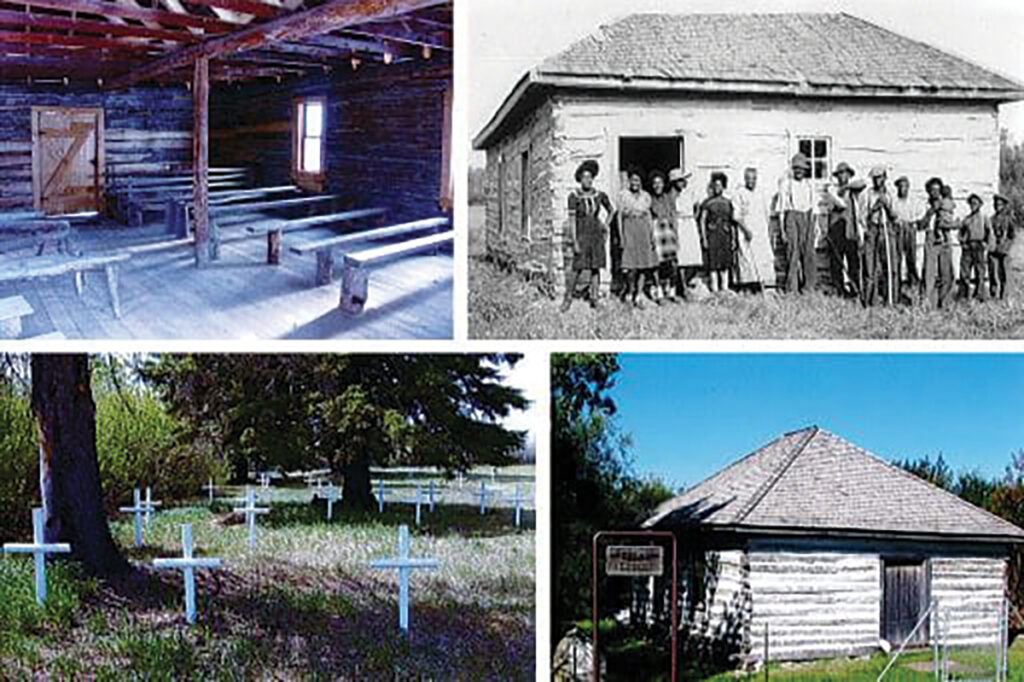
Just a few years later in 1912, a one-room log church was constructed and it was named the Shiloh Baptist Church.
I want to take a little sidebar and explore what the word Shiloh means. Personally, I’m fascinated by words, their origins and meanings. Merriam-Webster shows it’s a geographical name as it was the site of a major American Civil War battle in 1862. It’s also apparently a village in ancient Palestine on the slope of Mount Ephraim. It’s also a Hebrew name that means tranquil or peaceful.
I think it being a term meaning tranquility makes a lot of sense, if that was the intention.
The church was constructed of dovetailed, hand-hewn square poplar logs hauled by ox cart from the North Saskatchewan River. It was furnished with hand-made benches and a pulpit.
It became a focal point of community life and a vital social and religious centre for the close-knit community. The church remained in active use until the mid-1940’s. By that time, the community had largely moved away. The cemetery on the property is believed to hold 37 graves that were originally marked by large stones at the head and foot of each grave. In 2018, the Shiloh Baptist Church and Cemetery were given heritage status.
I’m no expert on the community or the church. There’re people that have studied and written books about the Shiloh people and I encourage anyone who’s interested to seek out that information.
I’m sure I’ll learn more at the end of the month from Leander Lane when he speaks at the museum. Maybe there’ll be a part two to this column. I’ll end this by saying I think in a time of growing separation amongst Canadians and Globally, it’s important to take a moment and reflect on the importance of understanding each other and our differences. In my line of work I get to speak with hundreds of people that I’ve never met. Each and every one teaches me something big or small. If you go into any situation with an open mind you’ll likely come out a better person and community member on the other side.
There’s no shame in not knowing something and it’s important to ask questions to get clarity on any given situation. The phrase we fear what we do not understand is used in countless forms of media, books, movies etc., and it’s true. If we took the time to understand the world would likely look like a totally different place.
I said at the start of my column that I was moved by the words of Coun. Charles Gustafson at the Feb. 2 regular council meeting in Lloyd. I encourage anyone to watch the video back and hear them first-hand. She spoke of her own experiences and highlighted the importance of coming together and hearing people’s stories throughout Black History Month. She said one thing that will stay with me forever.
“To our wider community, I know you might want us to know that you don’t see colour, but I want to tell you that we need you to. Not as a way to create separation or discrimination, but when you see all of us, you acknowledge that our life experience has informed what it means to be in this skin.”
Read more: Column: The brain game