


When you flush your toilet or wash something in your sink do, you know where the water goes?
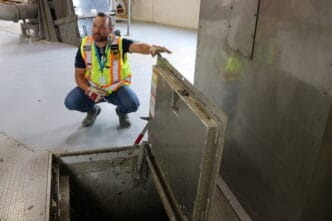
It all ends up in a central location in Lloydminster at the Wastewater Treatment Plant (WWTP).
Read more: Wastewater partners celebrate
Inside the large plant is a fish tank filled with effluent from the plant. It stands as a testament to the hard work, knowledge and process of the plant and its workers.

“That’s our quality right there,” said Lanny Code, wastewater treatment manager pointing to the tank. “We put on the tank; our effluent doesn’t kill fish.
“Part of our regulation is what’s coming from the end of this place. We actually
do toxicity testing.”
He said normally a water bladder full of effluent has trout put into it and they have to survive 96 hours to pass the test. They’ve opted to have fish live in the effluent and they regularly top up the tank.
Code says the big thing the plant has done is upgrade the treatment process.
“We were upgrading the equipment to do what we were doing prior, but we weren’t upgrading the treatment process,” he said.
The process may seem simple, dirty water goes in, clean water comes out, but there’s much more to it.
“Simplest way of treating wastewater is keeping your microorganisms healthy enough to remove all the contaminant that comes down the drain,” said Code. “We use certain chemicals, alum, citric acid and chlorine.
“They basically help treat with the membranes, help add to the flock, to help the bugs do the work.”
The bugs exist in the water to consume contaminants.
The plant uses the ZeeWeed membrane system from Veolia. A membrane for wastewater treatment is a long, narrow tube with billions of microscopic pores on the surface that are thousands of times smaller in diameter than a human hair. These pores filter water, allowing clean water to pass through while preventing virtually all particles from being discharged to the environment.
“It’s like very fine holes in a straw and somebody sucking from that straw, so it actually filters everything out,” said Code.
The water the WWTP treats then gets sent back to the North Saskatchewan River.
“Daily average flow from last year is 11,000-cubic metres a day,” said Code. “We do have the capability of treating 42,000-cubic metres a day.
“Our pipeline going to the river can only really take 28 (thousand-cubic metres).”
He says if the facility is unable to take on more capacity due to rain, then they have alternatives such as local stormwater channels.
The water from Lloydminster is destined to eventually hit the WWTP, a unique property of the location.
“We are the lowest elevation of Lloydminster,” said Code. “You’re getting it (water) whether you want it or not.”
Storm channel work around the city has worked to alleviate some of the potential pressure on the system if too much water enters it.
“They’ve increased the storm channels quite a bit in the last little bit to help deal with that,” said Code.
For Code, his interest in water started young, when he got sick after consuming
some water.
“I got super sick and so did a lot of players on my team,” he said. “We found out later, we all stopped at North Battleford. We all drank the water there. We got sick.”
Now, just over a year after the new WWTP opened in Lloydminster, a clear fish tank shows the success of the process and people at the plant.
Read more: Lloydminster continues work on projects