

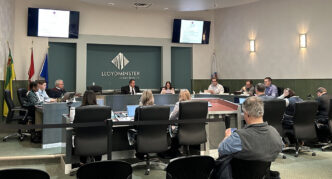
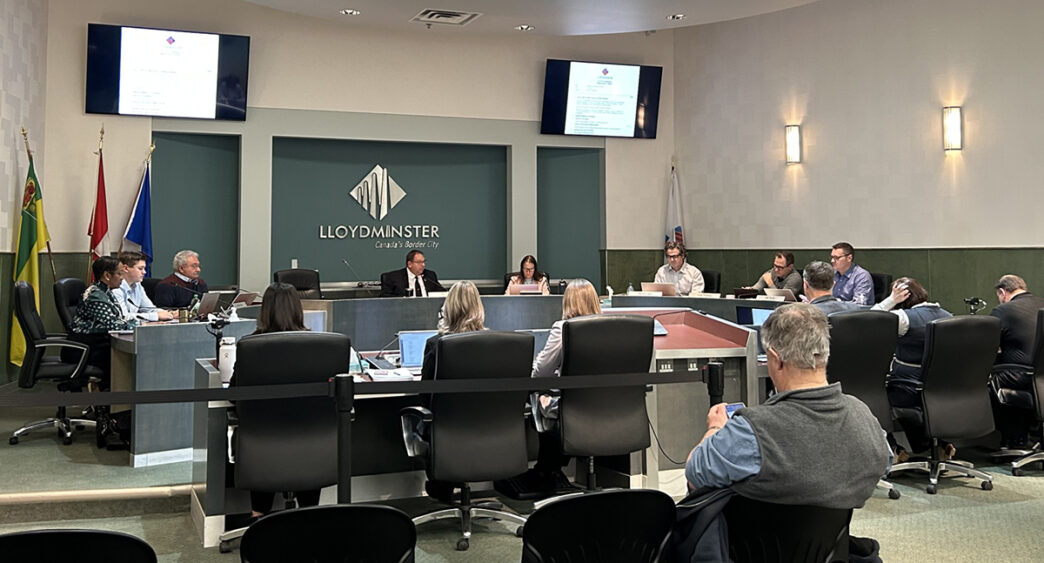
It’s officially in the books. The City of Lloydminster has approved its 2026 budget after two meetings and much debate.
Read more: Lloydminster budget 2026: what you need to know
Municipalities grapple with delivering a balanced budget every year. In 2026, the city approved an operating budget of $119.3 million and a capital budget of $29.9 million.
The city is facing a mill rate of 4.08 per cent, which would see an impact of $9 a month or $108 annually, on a home valued at $350,000. It’s also proposing a five per cent utility increase with assessment growth of 3.5 per cent. The utility and mill rate increases will be passed later in 2026 through their respective bylaws.
The first draft of the budget was presented on Nov. 5. Since then, new additions have been made.
An intergovernmental advisor position was added, Border City Connects’ funding increased by $12,000 and various expenses related to city council decreased by $6,400.
Changes were also made to proposed projects. The $30,000 City Hall renovation that would add a meeting room in the front hall of the building, removing a currently vacant vestibule, is no longer being funded. Another project that lost its funding status was the $35,000 inflatable obstacle course at the Bioclean Aquatic Centre. A $300,000 44 St. ditch and roadway widening project was also added to the capital budget.
The intergovernmental position is something administration sees as a big value to their operations.
“A lot of the work we do through the mayor’s office and through my own office at this point, we rely on other departments to supplement advocacy work, with not only one province, but two provinces, plus the federal government,” said city manager Dion Pollard.
“It’s one of the areas we feel we could enhance the services to the city. It doesn’t always relate to money, could be issues that we have. We’ve seen that through our liquor issue, our sandwich-gate issue. This position would support some of that and take some of the work off those individual departments that currently do that.”
Pollard clarified the starting position would be April 1, as presented in the budget.
“In the budget, it shows a start date of April 1, so it’s only taking 75 per cent of the year,” he said.
Comments and questions around the council table largely revolved around the proposed tax increase.
Coun. David Lopez asked if any of the taxation is transferred to reserves.
“In our operating budget, there is a portion of tax revenue that we put toward our reserves every single year with the intention of supporting our 10-year capital plan,” said Adele Wakaruk, executive manager of corporate services. “The reason why we put money into reserves is because it’s a substantial portion of how we fund our infrastructure year-over-year.”
The city will be transferring $16.6 million into reserves in the 2026 budget.
Lopez says a recent trip to the Alberta Municipalities convention left him wondering if the city could cut back on spending.
“When we went to Alberta Municipalities, the finance minister kind of laid the hammer down on everyone and said, ‘I don’t know if you looked at the price of oil but it’s below $60. If you think this year’s going to be bad, be prepared, it’s going to be two years of tough times,’” he said. “It stuck to me and maybe we have to tighten our belt strings a little bit.
“I’m just wondering if there’s projects we can take out this year that aren’t necessary that can be deferred for another year or two years and just see where the economy takes us.”
Lopez wondered if projects like the southeast area structure plan, the Russ Roberston heated bench warmers and the Cenovus Energy Hub playground, were necessary.
Administration said council could remove any projects it wished from the budget.
Pollard explained their contributions of reserves are something they don’t want to see cut back, but if council wished it, it could be done.
“Essentially, we’re relying on surpluses at the end of the year to fund our capital projects and it wasn’t sustainable,” he said. “We actually believe our contribution should be higher. If you look at the infrastructure gap that we have on a number of projects and you noted a couple there, we can take them off the books but what we don’t recommend is lowering the contributions to reserves.”
He did note that delaying projects like the southeast area structure plan delays the process and could potentially cost more to complete the following year.
Lopez doubled down on his want to see the tax rate cut back.
“I honestly believe we need to show the community that we’re doing something, we’re not in there going three, four, five per cent,” he said. “Even the city of Calgary, the new mayor at 3.6 per cent taxes, he’s gone back to administration and said ‘I want it lower.’
“We’re not the only ones looking at that, other communities are looking at their tax base and saying, ‘We need to do a little bit better.’”
For every one per cent taxation the city imposes, they get roughly $500K for it.
Coun. Michael Diachuk explained, while it may be a 4.08 per cent tax increase, a lot of it is going to necessary items for the city.
“Roughly three per cent of our budget goes to emergency services. Nobody’s going to argue about that,” he said. “If we’re looking at that 1 per cent of the budget as being that extra, that’s $500,000 that we’re seeing over and above an increase we’re wanting to find some savings in. That isn’t a lot of money when you consider the budget overall is $100 and some million dollars.”
He says it’s important to maintain a balance around reserves, something the city was previously lacking.
“Maintaining a balance around recognizing that we need to have reserves,” said Diachuk. “If we don’t have reserves, we’re borrowing, and that means you’re paying interest on that money and that impacts all your budgets. When you’re paying interest on borrowing, that leaves you less money to do the stuff you need to do within your budget.
“We didn’t have any when we started nine years ago. There was nothing. We’re at a point where we’re finally getting ahead in that regard. When projects come in, we have these reserves to at least give out a reasonable portion.”
Some notable increases this year include funding for protective services. The city’s overall budget saw an increase due to the new fire model being implemented, costing $1.2 million. The RCMP contract also increased by $249K due to a higher cost per officer.
Debt is also something the city will be balancing as there’s $55 million in existing debt and $102 million in existing and projected debt for 2026. Lloydminster will be paying $4.1 million in principal debt payments and $3.6 million in interest on long-term debt.
A major operating expense the city incurs is salaries and contracted work, with salaries costing more than $45 million and contracted services costing just over $30 million.
Coun. Michele Charles Gustafson doesn’t want to see service levels impacted.
“I don’t want service levels to suffer on those essential things,” she said. “I also very much think we cannot lose sight of planning for the future.”
Following council discussion, Pollard provided a list of projects administration was prepared to cut if council was looking to scale the budget back. Ultimately, council approved the 2026 budget with Councillors Vance and Lopez opposing the motion.
Council also approved the three-year operating plans starting in 2027, as well as the 10-year capital plan in principle, with Lopez opposing the motion.
Looking at the city’s 10-year capital plan, from 2026-2035, there’s $220 million in funded capital projects and $474 million in unfunded projects.
Budget at a glance:
- $119.3 million operating budget
- $29.9 million capital budget
- 4.08 per cent mill rate, 3.5 per cent assessment growth and five per cent utility increase
Top five capital projects:
- $4.5 million central business district replace program, phase 1B
- $3 million 2026 water and sewer replacement program
- $3 million replacement of 14 fleet units
- $2.7 million 2025 street improvement program
- $1.5 million clarifier structural repairs
Capital investments:
- Nearly $1.1 million in day-to-day assets to serve the public
- $2.5 million exterior and interior facility improvements
- $2.955 million fleet additions, replacement and repairs
- $1.97 million implementation of technology infrastructure
- $1.48 million parks construction and maintenance
- $4.5 million road construction, repairs and rehabilitation
- $161,560 stormwater management
- $1.61 million waste management
- $13.6 million water and wastewater system replacement
Read more: Hockey tournament proceeds to help Lloydminster family