


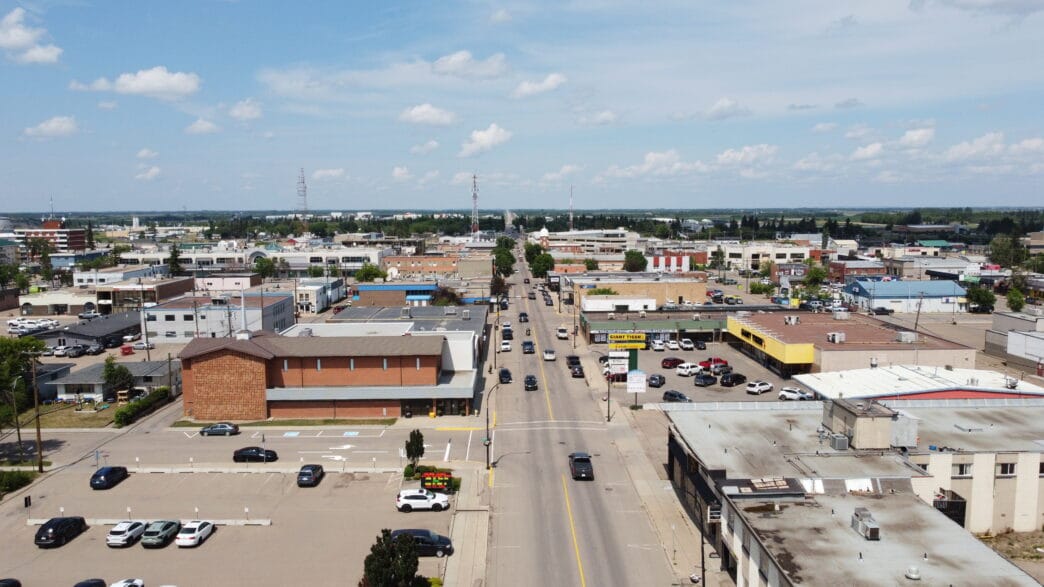
Lloydminster council has adopted an updated transportation master plan.
The plan, presented at the Nov. 24 council meeting, outlines the city’s needs as it grows and details the current state of its infrastructure.
Read more: Alberta and Ottawa energy deal to boost exports and jobs
The city’s transportation assets, local roads, collector roads, arterial roads, urban highways, rural roads and service roads, were all examined through this document.
“In total, you can see we have 513.45 total lane kilometres of existing roadway assets within our city,” said James Rogers, senior manager, capital infrastructure.
Scenarios outlined in the plan are divided into year segments, three-year, five-year, 10-year and 20-year horizons. The first scenario looks at short-term development through new collect and arterial connections.
The third scenario talks about expanding the network to support mid-term growth and the five-year scenario looks at addressing emerging congestion points. The 20-year horizon then addresses the implementation of major arterial upgrades and regional connections.
“Major arterial upgrades and regional connections, this is where we really start to forecast what our roadway networks look like at the 20-year horizon as well as the ultimate horizon,” said Rogers.
Recommendations through this document are intended to be phased and adaptive with flexibility to adjust based on development timing, funding available and community needs.
A north-south couplet was also examined, which would help with the flow of traffic to the north and south end of Lloydminster.
According to city documents, “The city has explored the potential for a North-South Couplet design along 50 Ave. (Highway 17), resulting in a preliminary design report in August 2011. In 2016, the city procured a detailed design for a North-South Couplet system that would convert 50 Ave. into a one-way southbound corridor and 49 Ave. into a one-way northbound corridor between 44 St. and 56B St. Transitional segments would connect the North-South Couplet to the broader two-way network at 35 St. (south) and 62 St. (north).”
Administration gave some insight into the view of how downtown traffic flows.
“The downtown isn’t a truck route anymore, so that was contemplated when the couplet was first brought forward,” said Don Stang, executive manager of operations. “Our desire, I think, is for the downtown to be more local than flowthrough.”
The recommendation of the masterplan is that the couplet concept be removed from the city’s long-term asset planning.
A bypass was also explored as an option through the master plan.
“Our traffic modelling right now would indicate we are not seeing a significant number of highways through trips. Let’s say a person is coming from the south travelling through Lloydminster to the north, say Paradise Hill, we are not seeing that,” said Rogers. “Lloydminster would be a destination or an originating point.”
Highway 16, on the other hand, sees additional through traffic.
“Highway 16, it’s a completely different case. We’re seeing upwards of 10 per cent or higher of vehicles along highway 16 that are through trips,” he said. “That helped us inform what bypasses we need to be looking at.”
While a Highway 17 bypass is not being recommended, the master plan talks about maintaining coordination with provincial and local governments regarding a Highway 16 bypass.
“Coming out of the masterplan, we would still encourage there is merit in encouraging how a highway 16 bypass could benefit the city of Lloydminster,” said Rogers.
A grade-separated rail crossing was explored as a way to get around the crossings on the north end of the city.
“The critical thing we were looking at as part of the transportation master plan was trying to determine where would be the most appropriate for a grade separated rail crossing,” said Rogers. “We looked at 40 Ave., 49 Ave., 50 Ave., 62 Ave. as well as 75 Ave., with 62 Ave. being deemed the most favourable spot if we were to put a grade-separated rail crossing.”
The cost of the crossing would be steep and the master plan only makes a recommendation that could be significantly lower than the actual cost.
“We can see within the plan that they’ve estimated around $47 million to put (in) a rail grade separation,” he said.
Mayor Gerald Aalbers asked if the master plan gets shared with Saskatchewan Highways and Transportation and Alberta transportation. Rogers says they can look at sharing it with the provinces.
Moving forward, next steps would see the recommendations and costs incorporated into the 10-year capital plan and the offsite levy bylaw.
Rogers also noted, the capital plan presented to council as part of budget deliberations, included recommendations from the transportation master plan.
Council adopted the 2025 transportation master plan in principle following council motion.
Read more: Standing Strong: Lloydminster confronts domestic violence







the city has not grown in 10 years. The population is stagnating.
They should of tought about transportation before maxing out the credit card on leisure activities like that small arena that anywhere else in Canada they would of got triple the size for that kind of cost.