

Disclaimer: The emergency scenario depicted below was created by Trace Associates for the training purpose of the Regional Emergency Management Collective and is fictitious in nature.
The City of Lloydminster and the Regional Emergency Management Collective recently tested their emergency protocols during a full day of training.
Read more: Pair of Lloydminster Bobcats earn AJHL honours
A scenario crafted by Trace Associates was the crux of Operation Whiteout, a training exercise led by the collective.
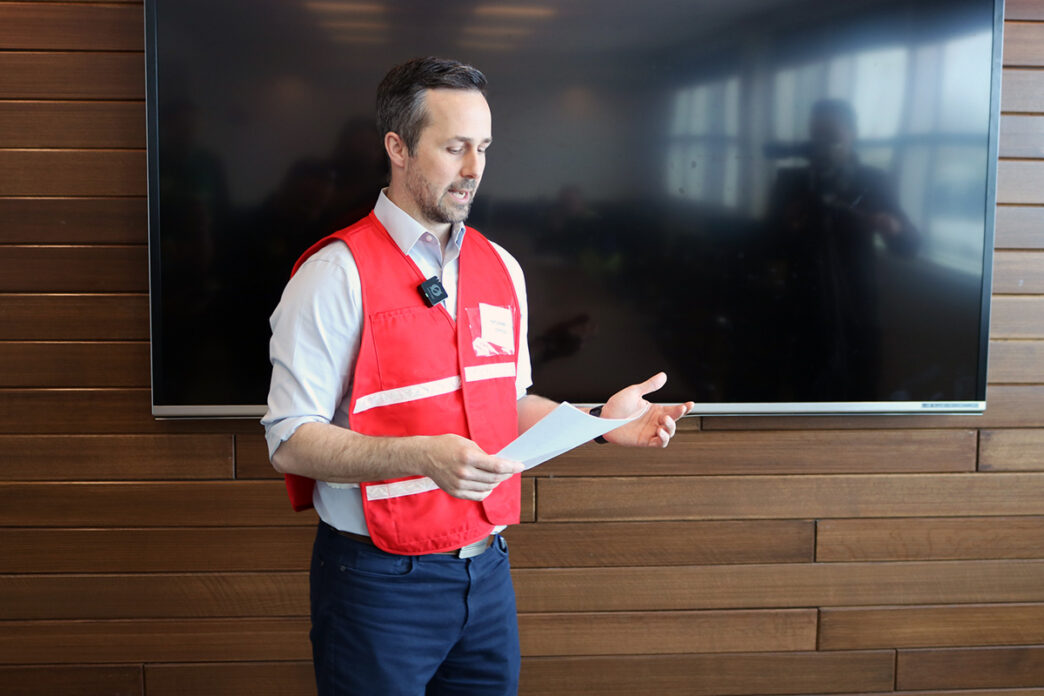
“The regional emergency management plan is a supportive plan for the regional emergency management collective,” said Andrew DeGruchy, the director of the Regional Emergency Management Collective. “We have 10 communities with five in Alberta and five in Saskatchewan.”
Leo Pare, the collective’s information officer, kicked off the training. He described a simulated emergency requiring a rapid response. The scenario began with a severe winter storm, mirroring the actual conditions outside the Lloydminster Operations Centre on April 15.
Pare noted the storm impacted the entire area with 30 cm of snow and -30 C temperatures. These conditions triggered cascading effects, including a crash in Kitscoty that released noxious gases and forced local evacuations.
Power and cellphone outages impacted Marwayne and people were evacuated. A bus crash in Lloydminster led to the death of a driver and injuries to students. Finally, the last part of the scenario was the collapsing of the arena roof in Vermilion.
The entire scenario, as laid out by the information officer, was concocted by Trace Associates as they put together a worst-case-scenario for the collective to respond to.
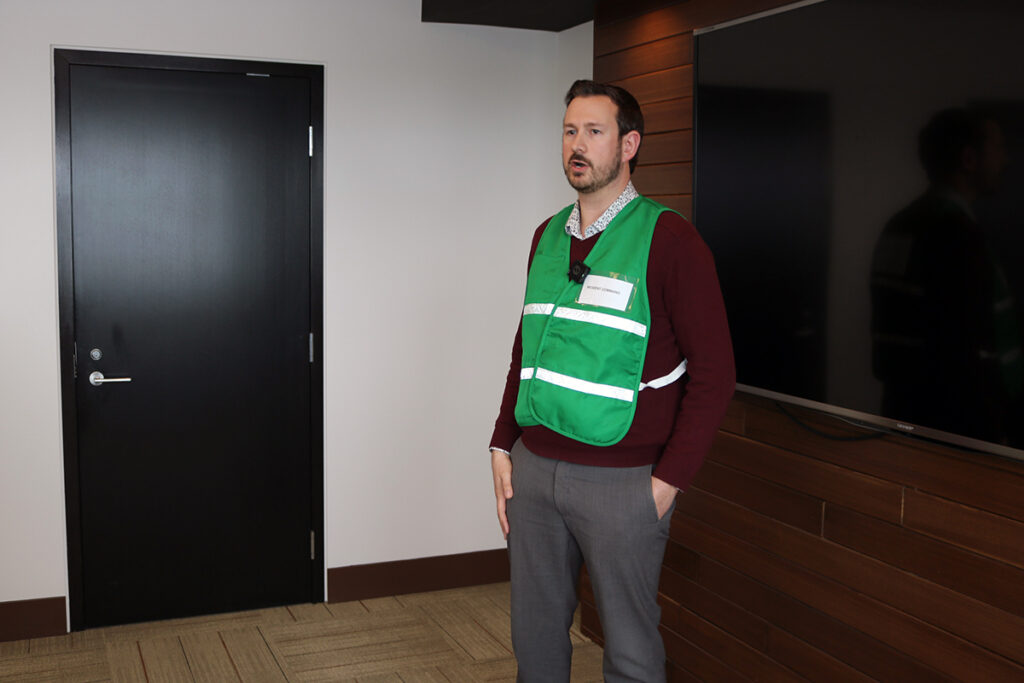
DeGruchy, who was also the incident commander for the event, laid out how Trace came up with the plan.
“We have a regional hazard index, or regional HIRA (hazard identification and risk assessment), of hazards we have in the community as well as scoring on it based off the frequency it could occur, or the severity,” he said, noting he was kept in the dark ahead of the event to simulate what a real disaster could look like.
Christian Apostolovski – Meridian Source
The emergency collective has been in development for the last six months. During this time, DeGruchy has assisted municipalities with new bylaws as they joined the group.
“Over the last six months, we’ve been creating a regional emergency management plan that showcases how, as a region, we jointly respond to hazards,” he said.
Member municipalities include the towns of Vermilion, Lashburn, and Marshall, and the villages of Kitscoty, Marwayne, and Paradise Valley. The RMs of Britannia, Wilton, and Eldon, along with the City of Lloydminster, are also part of the collective.
In this particular exercise, it was an opportunity for the power of the collective to fire up.
“We had 40 participants working in different functions,” said DeGruchy. “In simulating both different incident command posts at different field levels, a regional emergency co-ordination centre that helped to oversee all of the different command functions happening, as well as how did we transfer those local incident command posts into a regional incident command post so we could all respond in a joint venture.”
Lloydminster media was invited to attend and a participate in a mock media scrum.
“A portion of that was to do a mock media scrum and media exercise,” he said. “Throughout any exercise or hazard onset, communicating with the public is one of our primary functions. Ensuring that residents are aware of what actions we’re taking and what actions we would like them to take as well.”
DeGruchy noted that the team will become more familiar with the plan as they continue to use and practice it.
“It’s been a small group of people that have been creating the plan and now it’s ensuring that our regional partners, frontline staff and our first responders, understand the plan better,” said DeGruchy.
Although the training session proved to be a success in their implementation, he said there is still disasters that could overwhelm their resources.
“There’s certainly a number (of things) that could be overwhelming to our services,” he said. “The plan is intended to support If first responders are overwhelmed, what steps can we take to try to regain control of an incident.
“We see some multiple significant winter storms in a year. A winter storm could definitely overwhelm us as a community. How do we respond to it when it’s beginning to overwhelm us? How do we activate resources, how do we create control of that.”
Although many of the regional municipalities are part of the collective, the County of Vermilion River is not, something DeGruchy says is a barrier.
“We do see it as a barrier,” he said. “We did invite the County of Vermilion River to participate in the regional emergency management collective, but they did decline the offer. They have their own internal emergency management programming.
“We do talk with them on a pretty consistent basis around how are they going to respond to an emergency.”
He explained working together on disaster response in the future would be largely based on where it’s happening.
“I think it would be dependent on the hazard and what geographical areas it’s hitting,” said DeGruchy.
“We do continue to have open communications and dialogue with them related to what we’re doing for emergency management planning, should a hazard occur that impacts us both jointly.”
Read more: Canada, Saskatchewan commit $25.9M for 29,000 new homes